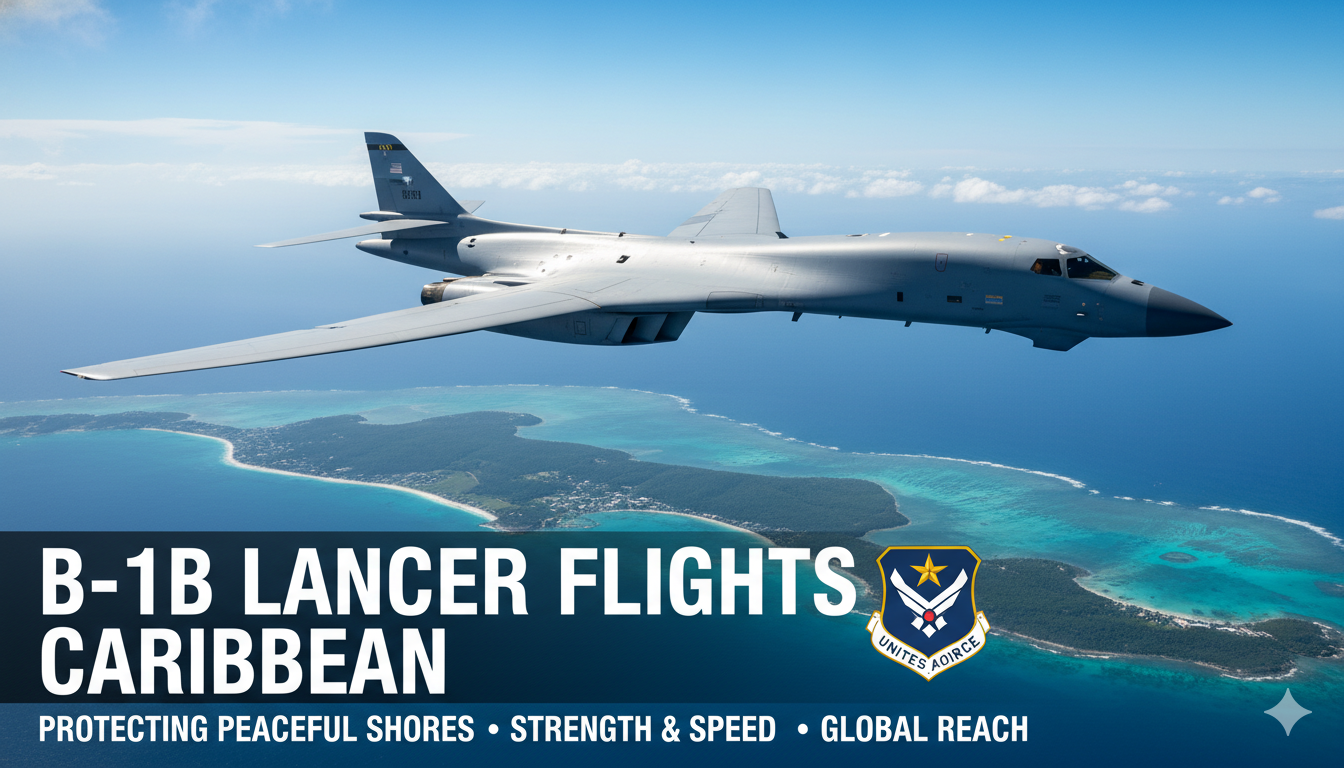
Have you ever looked up at the bright blue sky of the islands and wondered what protects those peaceful shores? While the islands are known for sun and sand, they are also a hub for some of the world’s most powerful planes. One of the most impressive sights in the air is the B-1B Lancer Flights Caribbean. These massive jets, nicknamed “The Bone,” are a staple of the United States Air Force. They represent strength and speed, often traveling thousands of miles to ensure the region stays safe.
The b-1b lancer flights caribbean are not just for show. These missions help pilots practice flying in different weather and allow the military to work closely with island nations. Seeing a B-1B Lancer in flight is a memory you won’t soon forget. It’s a sleek, powerful machine that can fly faster than the speed of sound. In this article, we will dive deep into why these planes fly over the Caribbean and what makes them so special.
What Is the B-1B Lancer?
Before we talk about the missions, we need to know the plane. The B-1B Lancer is a long-range, multi-mission bomber. It first started flying in the 1980s and has been a hero of the skies ever since. Unlike older bombers that are big and slow, the Lancer is built for agility. It uses “variable-geometry wings,” which means the wings can move back and forth depending on how fast the plane needs to go.
When you hear about b-1b lancer flights caribbean, you are hearing about a plane that can carry more weapons than almost any other jet. It was originally built to carry nuclear bombs, but today it only carries “conventional” weapons. This includes smart bombs and missiles that are very accurate. It is the backbone of the bomber force, providing a loud and clear message of protection wherever it flies.
The Importance of B-1B Lancer Flights Caribbean
Why does the Air Force choose this tropical paradise for its missions? The answer is simple: strategy. The Caribbean is a vital gateway for trade and travel. By conducting b-1b lancer flights caribbean, the military ensures that the sea lanes remain open and secure. These flights often act as a deterrent, which is a fancy way of saying they remind everyone that the U.S. is watching and ready to help.
Additionally, the Caribbean offers a unique environment for training. Pilots get to fly over vast stretches of water and navigate through tropical storm systems. This makes them better at their jobs. Every time a b-1b lancer flights caribbean mission takes place, it strengthens the bond between the U.S. and its neighbors. It shows that we are committed to the safety of the entire Western Hemisphere.
Detailed Biography of the B-1B Lancer
| Feature | Specification |
| Nickname | The Bone (from “B-One”) |
| Manufacturer | Rockwell International (now Boeing) |
| Top Speed | 900+ mph (Mach 1.2 at sea level) |
| Wingspan | 137 feet (Extended) / 79 feet (Swept) |
| Length | 146 feet |
| Engines | 4 General Electric F101-GE-102 Turbofans |
| Payload Capacity | 75,000 lbs (Internal) |
| Crew Size | 4 (Commander, Copilot, 2 Systems Officers) |
| Range | Intercontinental (Over 6,000 miles) |
High-Speed Training in the Tropics
When the b-1b lancer flights caribbean occur, the pilots are often practicing “low-level” flying. This means they fly close to the water or ground to hide from radar. Imagine a jet the size of a house zooming past just above the waves! It is a thrilling sight that requires incredible skill. The Lancer’s ability to hug the terrain makes it very hard for enemies to see it coming.
These training sessions are essential for staying sharp. The Caribbean provides a “real-world” classroom where crews can practice refueling in mid-air. This is when a giant tanker plane connects to the Lancer to give it more gas while they are still flying. Without these b-1b lancer flights caribbean, our pilots wouldn’t be as prepared for missions in other parts of the world.
Working with International Partners
The U.S. doesn’t fly these missions alone. Many b-1b lancer flights caribbean involve cooperation with countries like the Dominican Republic, Jamaica, or the Netherlands (via Curacao and Aruba). These partner nations often participate in exercises where they practice communicating and moving together in the air. It’s like a giant team-building exercise at 30,000 feet.
This teamwork is vital for stopping illegal activities, such as drug smuggling or human trafficking. While the B-1B is a bomber, its presence helps surveillance planes do their jobs better. When everyone sees the b-1b lancer flights caribbean on their radar, they know that the region is being monitored by the best technology available. It builds trust and shows that we are all on the same side.
The Technology Inside the “Bone”
You might wonder how a plane from the 1980s is still so good. The secret is constant updates. Modern b-1b lancer flights caribbean feature planes with “glass cockpits,” which means they have digital screens instead of old-fashioned dials. They also have advanced radar that can find a moving vehicle on the ground from miles away.
The electronic systems can even “jam” enemy signals. This means the plane can make itself invisible to certain types of radar or mess up the enemy’s radios. During b-1b lancer flights caribbean, these systems are tested to make sure they work in the humid, salty air of the ocean. It’s a high-tech marvel that keeps getting better with age.
A Day in the Life of a Bomber Crew
Being part of a b-1b lancer flights caribbean mission is a long day’s work. A typical flight can last over 10 hours. The crew of four sits in a cramped space, surrounded by computers and controls. They have to stay focused the entire time, monitoring the engines, the weather, and their mission goals. It’s a job that requires a lot of coffee and even more patience!
Even though they are flying over beautiful islands, the crew doesn’t get much time to sightsee. They are busy calculating fuel or checking their flight path. However, most pilots say that seeing the turquoise water from the cockpit during b-1b lancer flights caribbean is one of the best perks of the job. It’s a reminder of the beautiful world they are working so hard to protect.
Environmental and Noise Awareness
The Air Force knows that the Caribbean is a delicate place. When planning b-1b lancer flights caribbean, they take great care to avoid sensitive wildlife areas. They also try to fly high enough so that the noise doesn’t bother people on the ground or the animals in the sea. The goal is to be a “good neighbor” while still getting the training done.
Sometimes, people might hear a “sonic boom” if a plane goes supersonic, but this is usually done far out over the open ocean. During b-1b lancer flights caribbean, the military follows strict rules to keep the peace. They want the residents of the islands to feel safe, not startled. This respect for the environment is a big part of why these missions are successful.
Looking to the Future of Caribbean Missions
As we look toward the 2030s, the B-1B will eventually be replaced by the new B-21 Raider. However, for now, the b-1b lancer flights caribbean remain a top priority. The plane is still the fastest and most versatile bomber we have for these types of missions. It can get to the Caribbean from its home bases in Texas or South Dakota in just a few hours.
The lessons learned during b-1b lancer flights caribbean will help the next generation of pilots. The data gathered from these tropical flights tells engineers how to build even better planes in the future. So, the next time you hear a distant rumble in the sky, remember that it’s likely a Lancer doing its part to keep the world a little safer.
Conclusion: A Legacy of Protection
The b-1b lancer flights caribbean are a symbol of strength and partnership. These missions show that the U.S. Air Force is always ready to support its friends and protect the skies. From the incredible technology inside the plane to the brave crews that fly them, the B-1B Lancer is truly a legend. It’s more than just a jet; it’s a flying shield for the islands we love.
We hope you enjoyed learning about the “Bone” and its tropical adventures. Do you have a favorite military plane, or have you ever seen a B-1B in person? Let us know your thoughts! Staying informed about our world’s security is a great way to appreciate the peace we enjoy every day.
Frequently Asked Questions
1. How fast can a B-1B Lancer fly during these missions?
During b-1b lancer flights caribbean, the plane can reach speeds over 900 miles per hour. This is faster than the speed of sound!
2. Is the B-1B Lancer still a nuclear bomber?
No, since 1994, the B-1B has been converted to carry only conventional (non-nuclear) weapons. It is now used for precision strikes and support.
3. Why is the B-1B Lancer called “The Bone”?
The name comes from the designation “B-1.” If you say “B-One” quickly, it sounds like the word “Bone.” The name stuck and is now used by everyone in the Air Force.
4. Where do the b-1b lancer flights caribbean take off from?
Most of these planes are based at Dyess Air Force Base in Texas or Ellsworth Air Force Base in South Dakota. They fly long distances to reach the Caribbean.
5. Can the B-1B Lancer land on small Caribbean islands?
Usually, no. The B-1B is a very large and heavy plane that needs a long, strong runway. They mostly fly over the region or land at large military-ready airfields like those in Puerto Rico.
6. How many crew members are on the plane?
Every Lancer has a crew of four: a commander, a copilot, and two officers who handle the weapons and defense systems.